Eyebrow: AI OPERATIONS, QUALITY REVIEW & ONGOING IMPROVEMENT
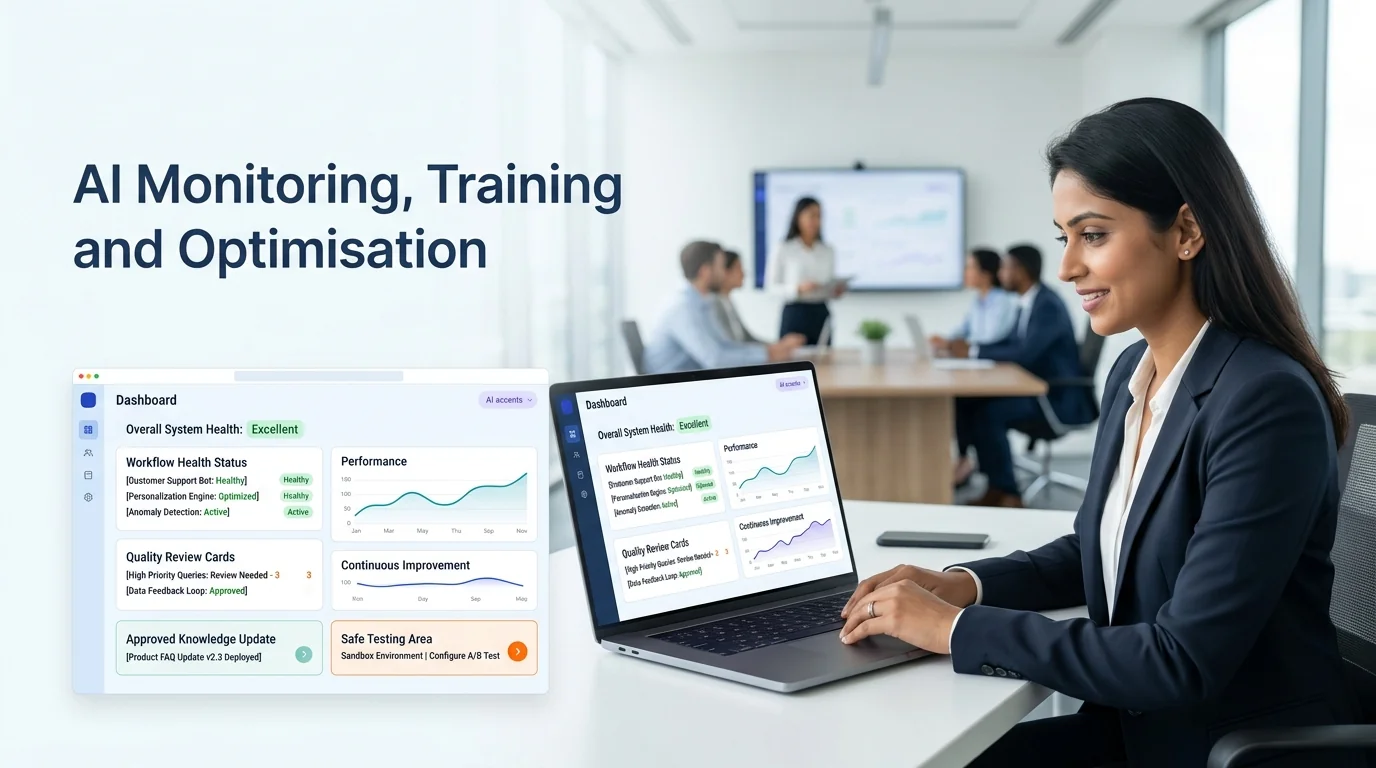
AI Monitoring, Training & Optimisation That Keeps Your AI Systems Useful After Launch
Launching an AI chatbot, voice assistant or workflow is not the end of the project. Business information changes. Customers ask unexpected questions. APIs update. Team processes evolve. A workflow that worked in a demo can become unreliable if no one owns the quality, knowledge and exceptions after launch.
Growlixa provides AI monitoring, training and optimisation support for businesses that want their AI systems to remain useful, safe and aligned with real operations. We review workflow health, output quality, customer questions, escalation patterns, knowledge gaps and team feedback—then improve the parts that need attention.
The goal is not to keep changing prompts for the sake of activity. It is to create a dependable operating rhythm for AI systems that affect customers, leads, documents, sales and business decisions.
Primary CTA: Plan Your AI Operations Support →
Supporting line: Monitoring · Quality review · Knowledge updates · Team training · Testing · Managed improvement
An AI system without maintenance becomes a hidden operational risk
AI systems can fail quietly. A chatbot may start answering an outdated question. A calendar integration may stop working after an update. A CRM field may change. A workflow may process a new type of document incorrectly. A support assistant may receive questions it was never designed to handle.
Without monitoring, the business may only notice after customers complain or leads are missed.
A mature AI operations model looks like this:
This is how AI becomes a business system rather than a one-time experiment.
What is AI monitoring, training and optimisation?
AI monitoring, training and optimisation is the ongoing work required to keep deployed AI systems reliable and useful.
It can include:
- workflow health monitoring;
- error and exception review;
- AI output quality review;
- conversation and call analysis;
- knowledge-base updates;
- prompt, rule and guardrail refinement;
- evaluation tests;
- integration maintenance;
- cost and usage review;
- team training;
- documentation and runbooks;
- access and permission review;
- release management;
- new use-case prioritisation.
It is not “training an AI model” in every case. Often it means keeping the approved knowledge, business rules, workflows and human escalation paths current.
What Growlixa AI operations support includes
AI system health and workflow monitoring
We review whether the system is working as designed.
Depending on the implementation, this may include:
- workflow completion and error events;
- integration availability;
- failed actions and retries;
- call / chat / message delivery outcomes;
- API or webhook failures;
- booking or CRM update completion;
- document-processing exceptions;
- dashboard refresh status;
- access or permission issues;
- alert configuration.
The right monitoring level depends on how important the workflow is and what business impact occurs if it fails.
Quality and outcome review
A workflow can run successfully and still produce poor customer or business outcomes. We review quality through:
- sample conversation review;
- call summary and handoff review;
- support ticket outcomes;
- lead qualification context;
- knowledge-answer relevance;
- document extraction exceptions;
- user feedback;
- human override patterns;
- customer complaints or repeated questions;
- sales and support-team feedback.
This review identifies whether the issue is source knowledge, prompt logic, integration, business rule, user experience or team process.
Knowledge and business-rule updates
AI systems need current information. We define a process for updating:
- service details;
- product information;
- policies;
- pricing guidance where approved;
- operating hours;
- FAQs;
- booking rules;
- escalation contacts;
- CRM fields;
- workflow conditions;
- document templates;
- approved response boundaries.
Updates should have ownership. A system is not maintainable if nobody knows who approves a change.
Evaluation and regression testing
When an AI system is updated, it should be tested before the update reaches real customers or critical workflows.
We can maintain an evaluation set of realistic scenarios:
- common user questions;
- difficult wording and language variation;
- incomplete inputs;
- sensitive requests;
- low-confidence retrieval;
- booking conflict;
- integration failure;
- duplicate lead;
- document anomaly;
- human handoff;
- permission boundary.
This helps confirm that an improvement in one area does not break another part of the workflow.
Prompt, guardrail and workflow optimisation
Optimisation may involve:
- clearer system instructions;
- improved knowledge retrieval;
- better question order;
- refined qualification logic;
- updated escalation rule;
- improved response format;
- lower-friction booking flow;
- better data validation;
- reduced unnecessary AI calls;
- improved human-review queue;
- more useful dashboard alert.
Every change should be tied to a problem observed in real use.
Team training and adoption
AI systems work best when the team understands what they do and what they do not do.
We support training around:
- how to review AI handoff;
- how to update approved knowledge;
- how to correct workflow outcomes;
- how to use CRM or dashboard context;
- what to escalate;
- how to identify a system issue;
- how to give useful feedback;
- how to communicate responsibly with customers;
- who owns each system component.
Training creates operational confidence and prevents the system from becoming dependent on one external person.
Documentation, governance and support rhythm
We document key elements such as:
- workflow purpose;
- system map;
- data source and access;
- known limitations;
- escalation path;
- approval process;
- update owner;
- test process;
- support contact;
- release history;
- monitoring / alert approach.
The support cadence can be designed around business need: launch stabilisation, monthly review, quarterly optimisation or a managed operations arrangement.
From customer input to a useful business action
Every Growlixa AI workflow is designed around clear actions, reliable data movement and human escalation where needed.
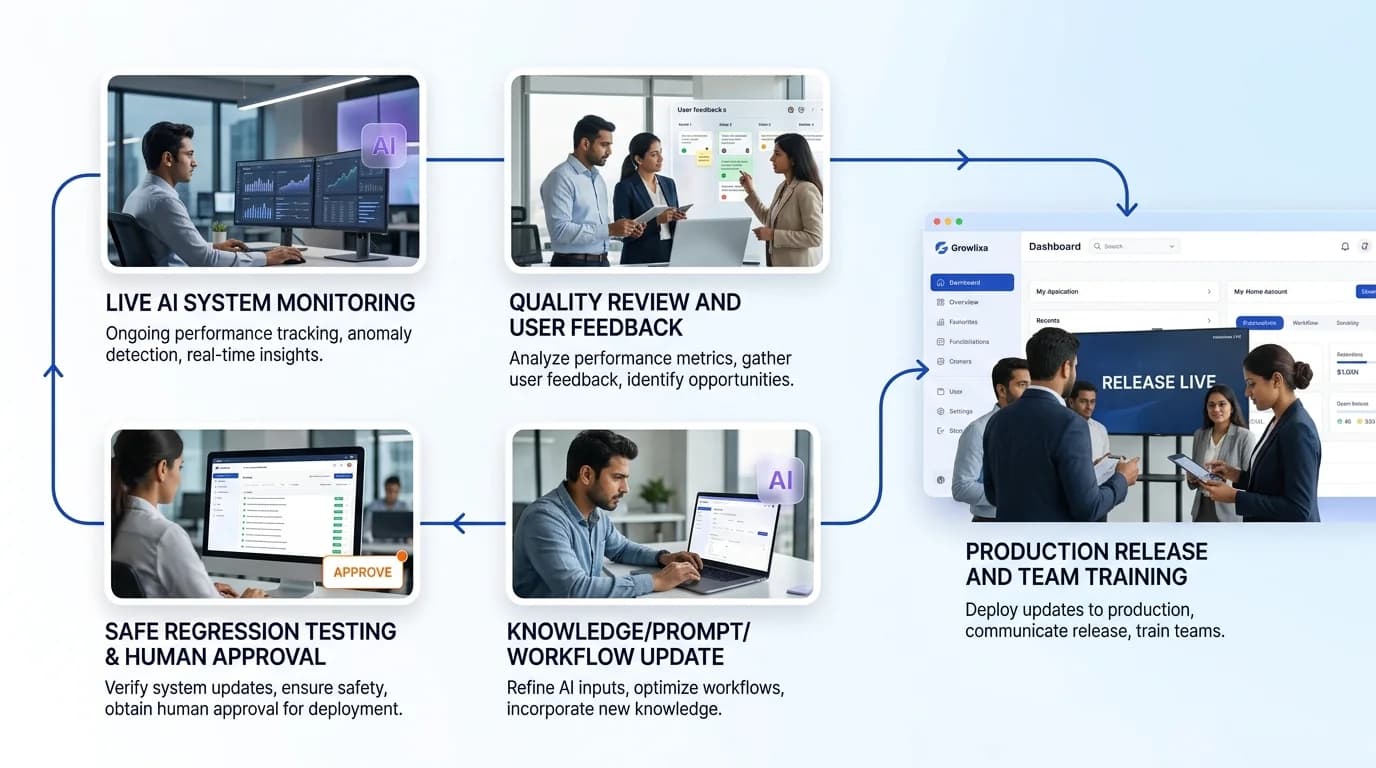
The Growlixa AI operations workflow
Step 01 — Review the live system and business risks
Typical timing: initial support assessment
We identify active AI workflows, customer or operational impact, current ownership, recent issues and the most important risks.
Deliverable: AI operations baseline and support-priority map.
Step 02 — Define health, quality and business measures
Typical timing: Week 1
We decide what needs monitoring: workflow completion, output quality, booking action, lead handoff, document exception, support issue or customer feedback.
Deliverable: monitoring and quality-review framework.
Step 03 — Establish update, testing and approval process
Typical timing: Week 1–2
We define knowledge ownership, change request process, test scenarios, approval steps and release method.
Deliverable: AI change-management and evaluation plan.
Step 04 — Train the team and launch operating rhythm
Typical timing: based on scope
We train relevant users, document the workflow and begin the agreed review cadence.
Deliverable: team enablement session, runbook and support schedule.
Step 05 — Improve based on real evidence
Typical timing: ongoing
We review errors, quality patterns, user feedback and new business requirements to prioritise improvements.
Deliverable: recurring AI operations report and optimisation backlog.
What can be monitored and improved
| AI system | Common operations focus |
|---|---|
| AI chatbot | Knowledge gaps, handoff, answer quality, lead capture and customer feedback |
| WhatsApp automation | Message flow, qualification, booking, handoff and opt-out handling |
| AI calling assistant | Call outcome, transfer, booking, CRM summary and voice / language quality |
| AI receptionist | Availability, booking accuracy, reminder flow and urgent escalation |
| CRM automation | Lead assignment, task creation, data quality and pipeline adoption |
| Document automation | Extraction quality, validation failures, review queue and system updates |
| RAG knowledge system | Source freshness, retrieval quality, access rules and unanswered questions |
| Reporting system | Data freshness, metric quality, alert usefulness and decision follow-through |
When managed AI support is especially valuable
This service is useful when:
- AI touches customer communication;
- an automation updates CRM, calendar, documents or operational systems;
- multiple teams use the system;
- knowledge changes regularly;
- the workflow has high commercial or customer impact;
- the business needs documented ownership and escalation;
- the team wants continuous improvement instead of one-time setup;
- an internal team needs training to manage the system confidently.
What AI monitoring should not become
Monitoring should not become endless dashboard watching or unnecessary prompt changes. It should not:
- change working systems without a reason;
- hide error patterns from the business;
- use customer data beyond approved purpose;
- release changes without testing;
- remove human escalation for the sake of automation rate;
- keep teams dependent on undocumented external knowledge;
- make performance claims without reliable measurement.
How success is measured
Relevant measures may include:
- workflow reliability;
- issue detection time;
- error and exception resolution;
- output-quality trend;
- knowledge freshness;
- evaluation performance on approved scenarios;
- human-handoff quality;
- team adoption and confidence;
- reduction in repeated manual intervention;
- customer or employee feedback;
- documented ownership and support readiness.
The goal is a system that remains useful and manageable as the business evolves.
Related Growlixa AI solutions
AI Monitoring, Training & Optimisation supports every other AI solution, including:
- AI Strategy & Automation Audit;
- AI Workflow Automation;
- AI Chatbot Development;
- WhatsApp AI Automation;
- AI Calling Assistants;
- AI Receptionist & Appointment Booking;
- AI Lead Qualification & Sales Follow-Up;
- CRM & Sales Automation;
- AI Knowledge Base & RAG Systems;
- AI Document & Data Automation;
- AI Reporting & Business Intelligence;
- Custom AI Web Apps & MVP Development.
Frequently asked questions
Why does an AI system need monitoring after launch?
Business knowledge, customer questions, integrations and workflows change. Monitoring helps identify errors, outdated content, weak outputs, failed actions and new opportunities before they create larger customer or operational problems.
What does AI optimisation involve?
Optimisation can include updating approved knowledge, improving workflow rules, refining prompts, testing edge cases, improving human handoff, adjusting integrations and training the team based on real use.
Do you retrain the AI model itself?
Not every system requires model training or fine-tuning. Many improvements come from better knowledge sources, retrieval, rules, prompts, evaluation and workflow design. The right approach depends on the use case.
Can our team update the knowledge base?
Yes. We can define roles, approval process, documentation and training so designated team members can update approved business information safely.
How do you test changes before they go live?
We create an evaluation and test process using realistic scenarios, including common questions, exceptions, sensitive cases, integration failures and human handoff. Changes should be validated before release.
What happens if an AI workflow fails?
A reliable support model includes error alerts, retry rules, fallback paths, human review and clear ownership. The exact response depends on the workflow’s business impact.
Can you train our staff to use and manage AI systems?
Yes. Training can cover workflow purpose, handoff, knowledge updates, feedback, exception handling, dashboard interpretation and escalation responsibilities.
Is managed AI support only for large companies?
No. The right support level depends on the number of workflows, business impact, team capacity and how frequently the underlying information changes. Small teams can benefit from a focused monitoring and update process.
Ready to keep your AI systems useful after launch?
Growlixa will review your live AI workflows, business dependencies, team ownership and quality risks. Then we will create the monitoring, training and improvement rhythm that helps your systems remain reliable as the business changes.
Primary CTA: Plan Your AI Operations Support → /contact
Microcopy: Reliable systems · Better quality · Team confidence · Continuous improvement