Eyebrow: CONVERSATIONAL AI, LEAD CAPTURE & CUSTOMER SUPPORT
AI Chatbot Development That Gives Customers a Useful First Response—Not a Dead End
A customer visiting your website may have a simple question, a complex requirement or a reason to buy today. If they cannot find an answer quickly, they leave. If they submit a form and wait hours for a response, the conversation often goes to a competitor.
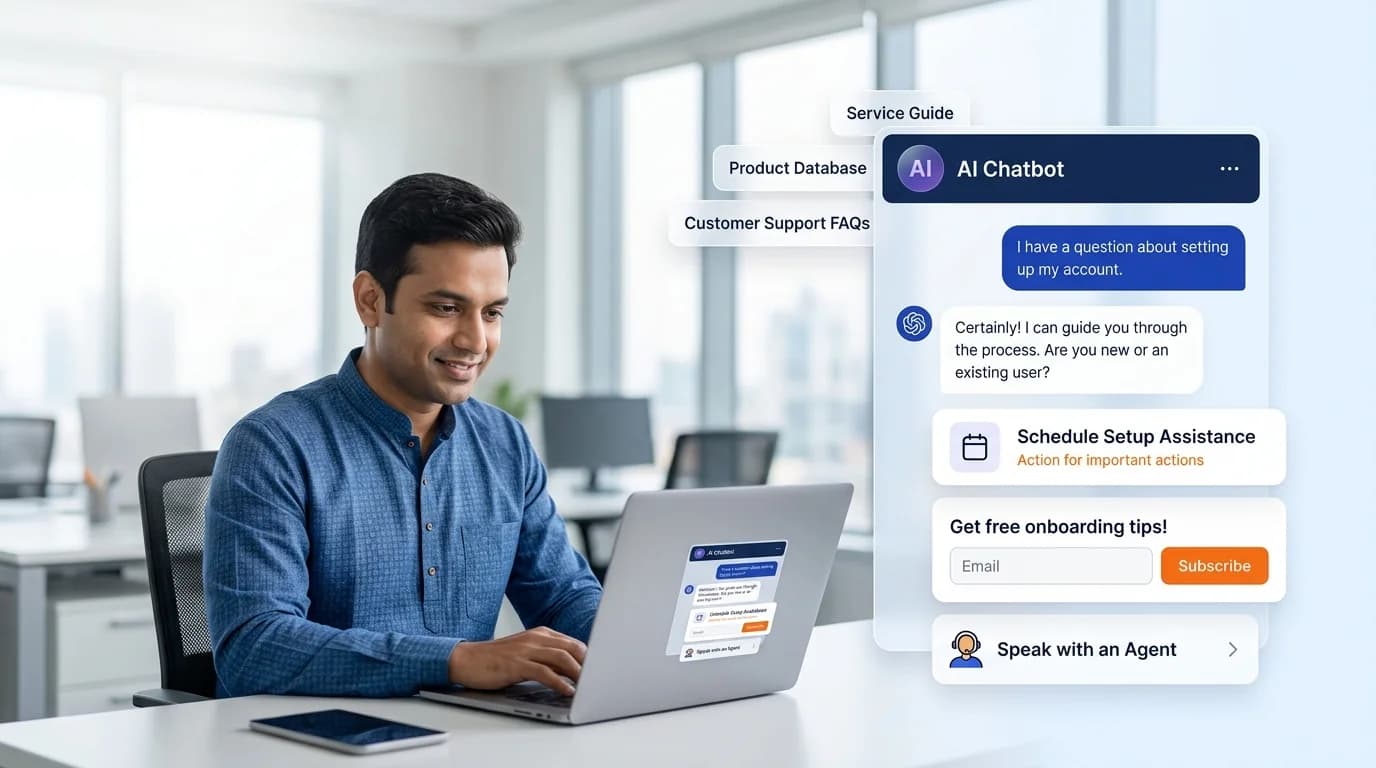
Growlixa builds AI chatbots that help businesses respond faster while keeping people in control of important conversations. A well-designed chatbot can answer approved questions, collect context, qualify an enquiry, offer a booking path, update a CRM and transfer sensitive or complex requests to the right person.
The goal is not to place a chat bubble on a website. The goal is to create a conversation that helps the customer move forward and helps your team receive the context they need to respond well.
Primary CTA: Plan Your AI Chatbot →
Supporting line: Website chat · Approved knowledge · Lead qualification · CRM integration · Human handoff
A useful chatbot does more than answer FAQs
A basic chatbot follows a short script. It can answer a few fixed questions, but it becomes frustrating when a customer phrases something differently, asks a follow-up question or needs help with a real business process.
A production chatbot needs a clearer system:
This is why Growlixa starts with the customer journey and business knowledge before choosing a model or designing a chat interface.
What is AI chatbot development?
AI chatbot development is the process of designing, building, testing and maintaining a conversational system that can understand natural language and perform useful business actions.
Depending on the use case, a chatbot may:
- answer website questions from approved information;
- capture a new lead;
- ask qualification questions;
- book a consultation or appointment;
- route a customer to the right team;
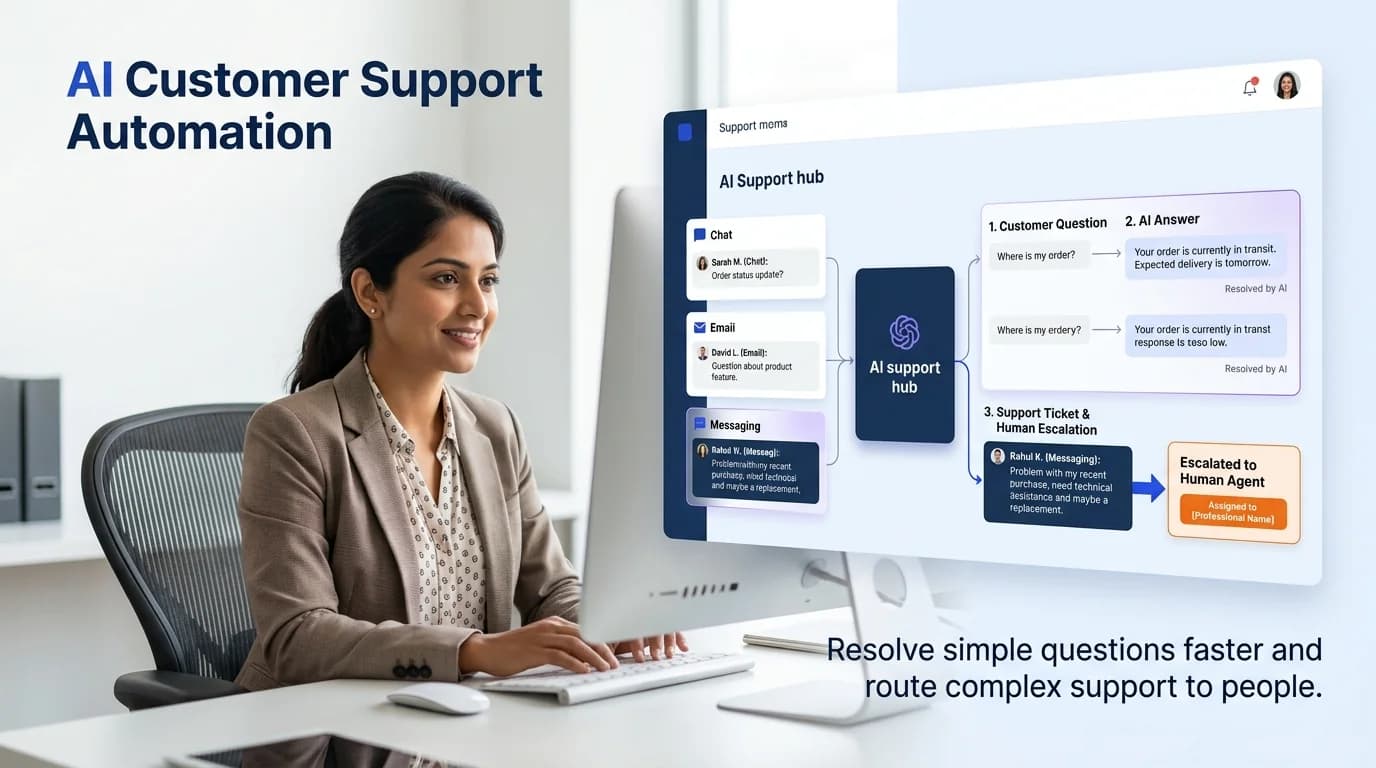
- create a support ticket;
- provide product or service guidance;
- retrieve policy, document or knowledge-base information;
- update CRM records;
- hand off a conversation with full context to a human.
A chatbot should not invent policies, make sensitive decisions or act beyond the permissions and knowledge provided by the business. The best implementation is useful, controlled and transparent about when a human should take over.
What Growlixa AI chatbot development includes
Chatbot discovery and use-case definition
We begin by defining the job the chatbot should perform. A chatbot trying to do everything usually does nothing well.
We identify:
- the customer or employee audience;
- common questions and recurring requests;
- the channels where conversations happen;
- the business outcome: support, lead capture, booking, education or internal help;
- required data and permissions;
- the point where a human should take over;
- success measures and operational owner.
You receive: chatbot use-case brief, priority conversation map and implementation scope.
Customer-question and conversation design
A good conversation feels organised without feeling robotic. We design the paths customers are most likely to take.
This includes:
- welcome and expectation setting;
- common questions and direct answers;
- service / product discovery questions;
- lead qualification fields;
- booking or consultation route;
- fallback response when knowledge is unavailable;
- human-handoff wording;
- escalation for sensitive requests;
- language and tone guidelines.
The bot should communicate in the brand’s approved tone and avoid pretending to be human when it is not.
Knowledge preparation and RAG grounding
When a chatbot needs to answer beyond a small fixed script, it needs approved business knowledge. This may include:
- website content;
- FAQs;
- service documents;
- product catalogues;
- policies;
- SOPs;
- support articles;
- approved internal documents.
We review, structure and connect these sources so the chatbot can retrieve relevant information before responding. This is commonly called Retrieval-Augmented Generation, or RAG.
RAG can reduce unsupported responses by grounding answers in your business material. It does not create a guarantee of perfect output, which is why confidence rules, human handoff and ongoing review remain important.
Website chatbot design and deployment
The visible chat experience should feel like part of your website, not a third-party interruption. We plan:
- chat-widget placement;
- greeting and proactive prompts where appropriate;
- mobile chat behaviour;
- quick actions and guided paths;
- accessibility and usable contrast;
- consent and privacy language;
- conversational flow and escalation options;
- website page context where helpful.
Lead capture, booking and CRM integration
A business chatbot should create useful action, not just conversation transcripts.
Depending on scope, it can:
- collect contact details and requirement;
- identify service interest;
- qualify lead criteria;
- schedule a meeting or appointment;
- create or update CRM records;
- assign an owner;
- send a follow-up notification;
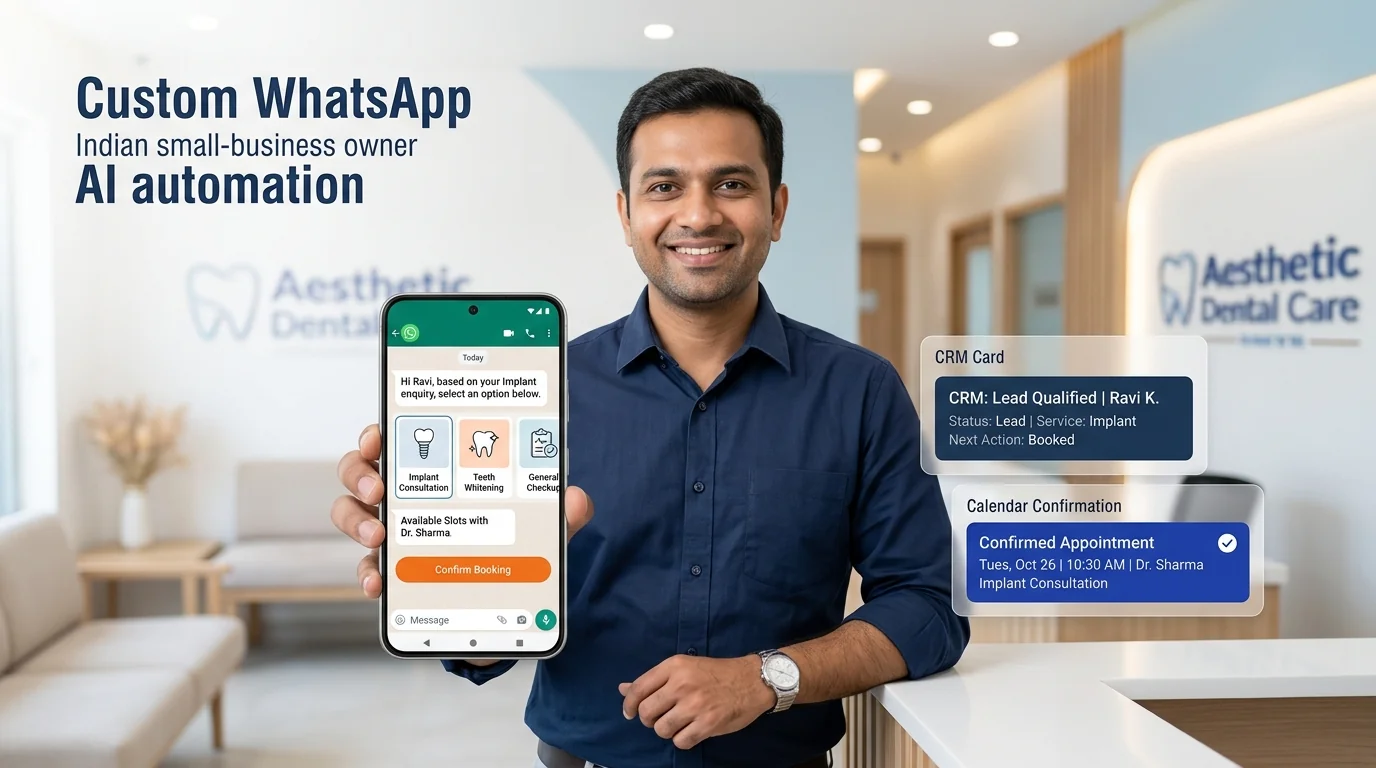
- trigger WhatsApp, email or task workflows;
- pass conversation summary to the team.
The exact action is based on the business process and approved integrations.
Human handoff and escalation
A chatbot needs to know when not to continue. We build clear handoff routes for:
- low-confidence answers;
- complaints;
- urgent matters;
- sensitive personal information;
- medical, legal or financial questions requiring a qualified professional;
- complex sales conversations;
- explicit customer request to speak with a person.
Where possible, the human receives the conversation context so the customer does not have to repeat everything.
Testing, evaluation and launch
Before launch, we test real scenarios, not only ideal questions. Testing can include:
- common customer questions;
- spelling and language variations;
- multi-turn follow-up questions;
- incomplete lead information;
- inappropriate or out-of-scope requests;
- inaccurate knowledge retrieval;
- human-handoff paths;
- CRM or booking action tests;
- mobile experience.
You receive: testing checklist, approved launch flow and escalation plan.
Analytics and continuous improvement
After launch, chatbot conversations reveal what customers actually ask. We review:
- top intents and unanswered questions;
- lead capture and booking completion;
- handoff rate;
- common fallback events;
- knowledge gaps;
- user feedback;
- action completion;
- quality and safety concerns.
These findings improve the knowledge base, conversation flow and human-support process over time.
From customer input to a useful business action
Every Growlixa AI workflow is designed around clear actions, reliable data movement and human escalation where needed.
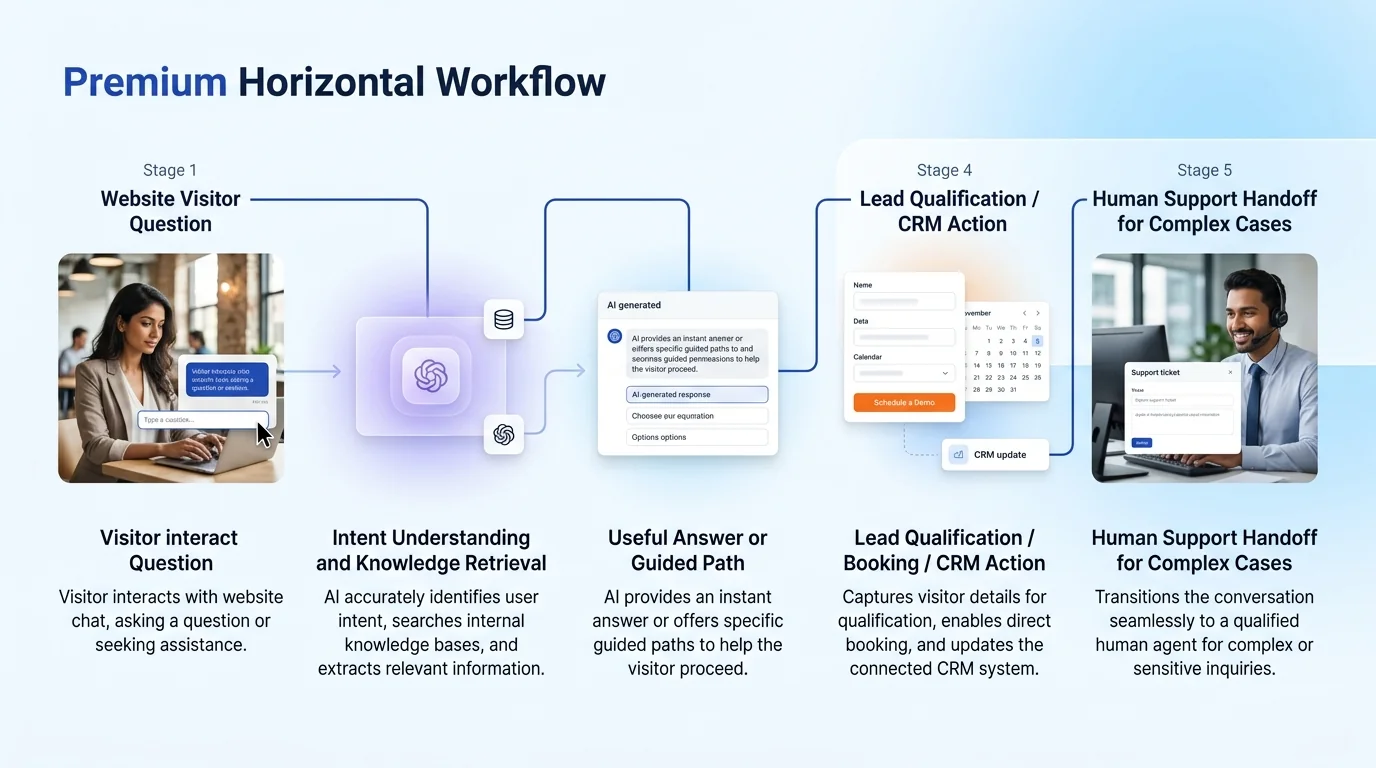
The Growlixa AI chatbot workflow
Step 01 — Define the one job the chatbot must do well
Typical timing: Days 1–4
We decide whether the first priority is lead capture, customer support, booking, internal knowledge or another clearly defined use case.
Deliverable: chatbot objective, target audience and success criteria.
Step 02 — Map questions, knowledge and customer paths
Typical timing: Week 1
We collect common questions, business rules, approved content, escalation requirements and desired actions.
Deliverable: conversation map, knowledge-source checklist and handoff rules.
Step 03 — Build the chatbot and integrations
Typical timing: based on scope
We configure the chat experience, knowledge retrieval, lead or booking paths and approved CRM / calendar / support integrations.
Deliverable: testable chatbot environment.
Step 04 — Test real customer scenarios
Typical timing: before launch
We test variations, exceptions, safety rules, handoff and downstream actions. The focus is on useful customer outcomes, not only chat quality.
Deliverable: evaluation checklist and launch approval.
Step 05 — Launch, observe and improve
Typical timing: ongoing
We monitor the questions customers ask, refine knowledge, review escalation and improve the conversation based on real use.
Deliverable: chatbot insight report and optimisation roadmap.
Chatbot use cases by business type
| Business type | Useful chatbot role |
|---|---|
| Clinic or wellness business | Service guidance, appointment request, location and human escalation |
| Hotel or hospitality business | Room / facility enquiry, availability request, booking handoff |
| E-commerce brand | Product guidance, order questions, return policy and support handoff |
| Manufacturer or B2B supplier | Product / capability enquiry, catalogue request and lead qualification |
| Real-estate business | Project questions, budget qualification and site-visit request |
| Education business | Course guidance, admission enquiry and demo-class booking |
| Professional service firm | Consultation intake, service explanation and meeting scheduling |
| Internal team | Policy, SOP, product or project knowledge retrieval |
What a chatbot should not do without human control
A premium AI solution is defined partly by its boundaries.
The chatbot should not:
- provide medical diagnosis, legal advice or financial recommendations without approved qualified escalation;
- invent product facts, prices, policies or availability;
- make high-risk decisions without human review;
- reveal information a user is not permitted to access;
- continue a sensitive conversation when a human should take over;
- claim certainty when the source information is incomplete.
We define these boundaries before launch.
How chatbot success is measured
The right metrics depend on the business use case. They may include:
- first response time;
- conversations completed;
- qualified leads captured;
- appointment or meeting requests;
- support questions resolved or correctly routed;
- human-handoff completion;
- common knowledge gaps;
- customer feedback;
- CRM data completeness;
- reduced repetitive support workload.
We do not promise a fixed automation percentage before understanding your customer volume, knowledge quality and workflow.
Related Growlixa AI solutions
AI Chatbot Development connects naturally with:
- AI Knowledge Base & RAG Systems;
- WhatsApp AI Automation;
- AI Customer Support Automation;
- AI Lead Qualification & Sales Follow-Up;
- CRM & Sales Automation;
- AI Integration & API Development;
- AI Monitoring, Training & Optimisation;
- Website Design & Development;
- Landing Pages & Conversion Optimisation.
Frequently asked questions
What is the difference between a rule-based chatbot and an AI chatbot?
A rule-based chatbot follows fixed buttons, scripts and decision trees. An AI chatbot can understand a wider variety of natural-language questions and, when connected to approved knowledge, can retrieve relevant information before responding. Both can be useful; the right choice depends on the task.
Can the chatbot use our own website, documents and FAQs?
Yes. We can prepare approved knowledge sources such as website pages, FAQs, service documents, product information and support content. Access, update process and permissions are defined before launch.
Can the chatbot capture leads and book appointments?
Yes. Within the agreed scope, the chatbot can collect lead details, ask qualification questions, route to a calendar or appointment flow and create/update CRM records.
Can the chatbot speak Hindi, English or Hinglish?
Modern AI systems can support multilingual conversations, but quality should be tested on your actual business content and customer language. We define language requirements during discovery.
What happens if the chatbot cannot answer a question?
The chatbot should state that it needs help, collect useful context if appropriate and hand the conversation to a human team member or support route. We configure this fallback before launch.
Is chatbot data secure?
Security depends on the systems, knowledge sources, access rules and deployment approach. We review sensitive data, permissions, approved integrations and appropriate escalation during planning. Do not place sensitive information in a workflow without a specific data review.
How long does it take to build an AI chatbot?
Timing depends on the use case, knowledge readiness, channels, integrations, testing and approval process. A focused chatbot can move faster than a multi-channel RAG system with complex workflows. We provide a practical plan after discovery.
Can Growlixa maintain the chatbot after launch?
Yes. Growlixa can support knowledge updates, conversation review, monitoring, testing and optimisation through AI Monitoring, Training & Optimisation services.
Ready to make your website conversations more useful?
Growlixa will review the customer questions your team receives, the actions you want visitors to take and the knowledge your business can approve. Then we will recommend a chatbot scope that creates useful customer outcomes—not just a chat bubble.
Primary CTA: Plan Your AI Chatbot → /contact
Microcopy: Useful answers · Clear handoff · Business-ready conversations