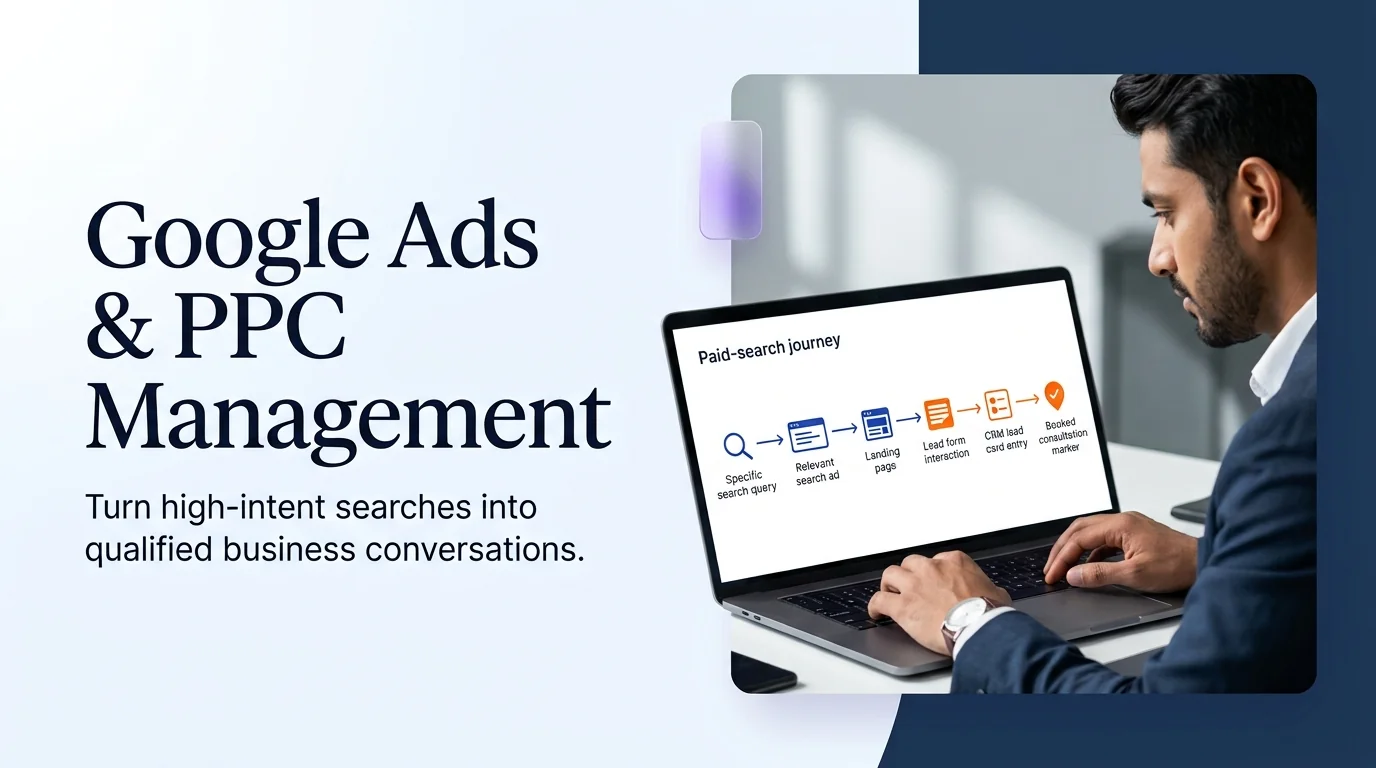
Eyebrow: HIGH-INTENT DEMAND GENERATION
Google Ads & PPC Management That Turns Search Intent Into Better Business Conversations
When a potential customer searches for a service you offer, timing matters. They may be comparing options, looking for a quote, ready to call, or trying to solve an urgent problem. Google Ads can place a relevant offer in front of that customer at the moment of intent—but only if the campaign, landing page, tracking and follow-up system work together.
Growlixa provides Google Ads and PPC management for businesses in Agra, across India and beyond. We build campaigns around real customer searches, clear offers and measurable actions such as qualified calls, quote requests, WhatsApp conversations, bookings, demo requests or sales.
Our approach is not simply to launch ads and report clicks. We examine the complete route from search term to business outcome, then improve the parts that affect lead quality and conversion.
Primary CTA: Request a Google Ads Opportunity Review →
Supporting line: Search campaigns · Conversion tracking · Landing-page optimisation · Lead-quality learning
A click is not a customer. A lead is not always a good lead.
Many businesses start Google Ads with a sensible expectation: if someone searches for the service, an ad should bring an enquiry. The problem is that ads can generate activity without generating the right business outcome.
A campaign may receive clicks from people outside the service area. A lead form may attract price shoppers who are not ready to buy. A landing page may be slow or unclear. Calls may go unanswered. A sales team may not know which lead came from which campaign. In these situations, a report can show traffic while the business feels no closer to growth.
That is why Growlixa treats PPC as a connected lead-generation system. We begin with your offer, customer type, geographic reach, sales capacity and conversion path. We then use data to refine targeting, budget, search terms, creative and landing-page experience over time.
What is Google Ads and PPC management?
Pay-per-click advertising, usually called PPC, is a model in which a business pays when an eligible user interacts with an ad. Google Ads can place campaigns across Google Search and, depending on the business objective, other Google-owned or partner inventory.
For many service businesses, Google Search campaigns are especially useful because the customer is actively expressing intent. A person searching for “website development company Agra,” “dentist near me,” “hotel booking Agra” or “industrial supplier India” is already looking for something specific.
Google Ads management is the ongoing work required to make those campaigns more relevant and commercially useful. It can include:
- search-intent and competitor research;
- account and campaign structure;
- keyword and negative-keyword management;
- ad copy and assets;
- location, audience and device settings;
- conversion tracking;
- landing-page review and conversion improvements;
- budget and bid management;
- call, form, WhatsApp, booking or purchase analysis;
- lead-quality feedback from the sales team;
- reporting and continuous optimisation.
The exact mix depends on your business. A clinic may prioritise appointment calls. A hotel may prioritise direct booking enquiries. A manufacturer may prioritise high-value quote requests. An e-commerce business may prioritise profitable purchases and repeat revenue.
What Growlixa Google Ads services include
Google Ads opportunity audit
Before recommending a campaign, we review whether paid search is the right next move. We look at your service or product demand, current website, target geography, sales process, historic campaign data where available and the actions you can realistically track.
We assess questions such as:
- Which services or products have enough commercial value to advertise?
- Which customer searches show strong buying intent?
- Which areas can you genuinely serve?
- What does a qualified lead look like for your team?
- Is the website or landing page ready to convert paid traffic?
- Can calls, forms, WhatsApp clicks, bookings or purchases be tracked?
- Does the business have the capacity to respond quickly?
- Are there existing campaigns wasting budget on irrelevant searches?
You receive: a paid-search opportunity view, initial account findings where access is available, priority campaign recommendations and realistic next steps.
Search-intent and keyword strategy
Paid keywords are not chosen simply because they have high search volume. We prioritise the searches most likely to match a commercial need.
A keyword plan can include:
- high-intent service searches;
- product or category searches;
- location-specific searches where relevant;
- competitor comparisons where compliant and commercially useful;
- emergency, booking, consultation, quote or purchase intent;
- negative keywords that reduce irrelevant traffic;
- search-term review after launch.
For example, a company selling premium B2B software may not want clicks from users searching for free templates, jobs, training or definitions. A local service provider may not want enquiries from cities it does not serve. Negative keywords and search-term learning are essential parts of responsible budget management.
You receive: intent-led campaign keyword groups, negative-keyword logic and a clear explanation of what the campaign is designed to attract.
Campaign structure and ad creation
We build campaigns so the ad, keyword and landing page make sense together. A person searching for a specific service should not be sent to a vague homepage.
Campaign work can include:
- account and conversion-action review;
- Search campaign structure;
- ad groups organised by service or intent;
- responsive search ad copy;
- relevant ad assets such as sitelinks, callouts, structured snippets, calls or location information where appropriate;
- geo-targeting aligned with real service coverage;
- schedule, device and audience observation settings;
- campaign naming and documentation for clean reporting.
We write ads to be useful and specific. We do not rely on exaggerated claims such as “#1,” “guaranteed results” or unsupported pricing just to increase clicks.
Conversion tracking and attribution foundation
Without reliable measurement, campaign decisions become guesswork. We plan tracking around the actions that matter to your business.
Depending on the business model and permissions, this can include:
- contact-form submissions;
- phone-call clicks and call reporting;
- WhatsApp clicks;
- calendar or appointment requests;
- quote requests;
- e-commerce purchases and revenue;
- lead-source capture in CRM;
- offline lead-quality or closed-sale feedback where possible.
We explain what can be measured directly, what requires CRM or sales-team input and what should be treated as directional data. Tracking needs to respect applicable consent, privacy and platform requirements.
You receive: conversion-measurement plan and implementation recommendations or setup within the agreed scope.
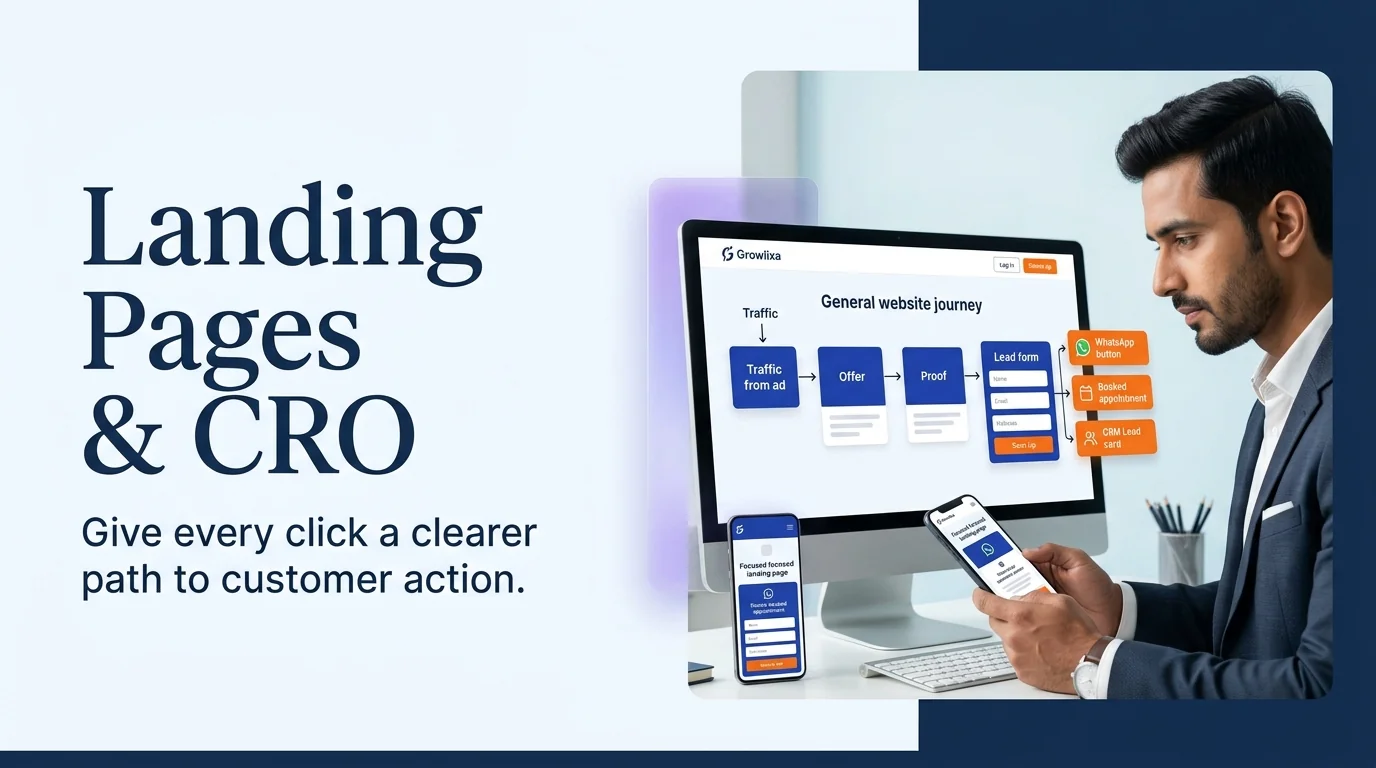
Landing-page and conversion review
Paid traffic is expensive when it reaches an unclear page. A campaign may be technically correct but still underperform because the landing page does not answer the customer’s first questions.
We review the conversion path for:
- message match between ad and page;
- headline clarity;
- service or product explanation;
- trust signals and proof;
- visual hierarchy;
- page speed and mobile usability;
- contact options;
- form length and friction;
- booking, WhatsApp or phone flow;
- next-step clarity.
Where required, we provide landing-page recommendations or build campaign-specific landing pages through the Landing Pages & Conversion Optimisation service.
Ongoing optimisation and lead-quality learning
The first campaign launch is the start of the learning process, not the finish line. We review the data, search terms, ad performance, conversion rate, costs and lead feedback to decide what deserves more budget, less budget or a different approach.
Ongoing optimisation can include:
- search-term analysis and negative-keyword additions;
- ad-copy testing;
- budget reallocation;
- bid and targeting review;
- audience observation analysis;
- location and device performance review;
- landing-page test recommendations;
- lead-quality review with your team;
- campaign expansion only when evidence supports it.
We avoid making changes just to appear busy. Each meaningful adjustment should have a reason, a hypothesis and a measurement plan.
Transparent reporting
A useful PPC report does more than list impressions and clicks. It helps a business understand what happened, what we learned and what happens next.
Reports can include:
- spend and budget pacing;
- impressions, clicks and click-through rate;
- conversion actions;
- cost per lead or cost per agreed conversion action;
- search-term insights;
- campaign and ad-group performance;
- call, form, WhatsApp, booking or purchase data where tracked;
- lead-quality observations;
- completed work and next-period priorities.
From customer discovery to a useful business action
Every Growlixa growth workflow is designed around clear customer journeys, useful information and measurable next steps.
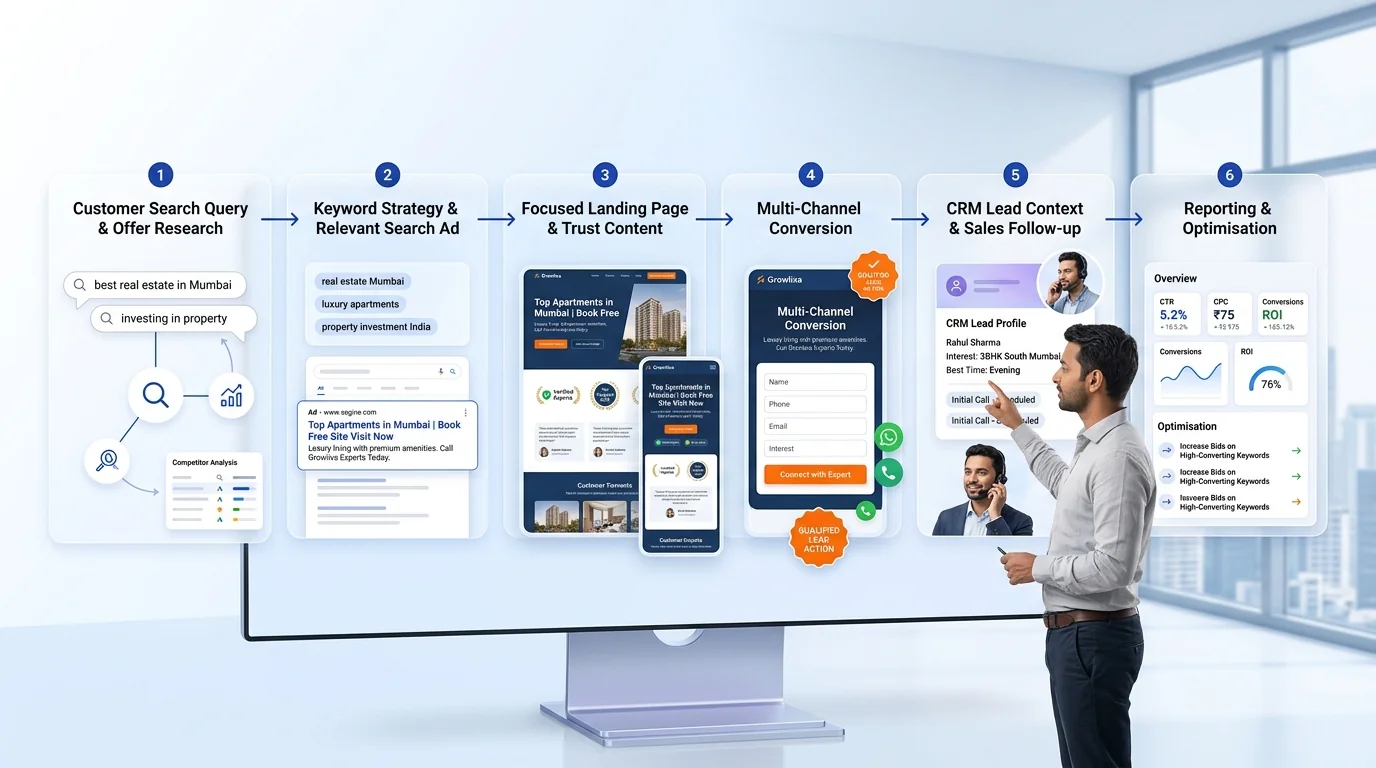
The Growlixa Google Ads workflow
Step 01 — Clarify the offer, customer and lead definition
Typical timing: Days 1–3
We begin with commercial reality. Which service or product is worth advertising? What is its average value? Which customer is a good fit? What happens after a call or form? How quickly can your team respond?
A campaign cannot fix a vague offer or a lead process with no owner. We identify these issues before spend begins.
Deliverable: campaign objective, ideal-customer profile, target geography and qualified-lead definition.
Step 02 — Audit demand, competitors and conversion path
Typical timing: Days 2–7
We research relevant searches, review visible ad competition, inspect existing account data where available and assess the landing experience. We identify search themes, exclusions, page gaps and tracking requirements.
Deliverable: paid-search plan, keyword themes, negative-keyword direction, landing-page findings and tracking checklist.
Step 03 — Build measurement before scaling spend
Typical timing: Week 1
We configure or validate agreed conversion actions. This may include forms, calls, WhatsApp clicks, booking requests, purchases or CRM source capture. We test the journey before campaigns go live.
Deliverable: tested conversion-action setup or developer-ready implementation instructions.
Step 04 — Create campaigns, ads and assets
Typical timing: Week 1–2
We build the campaign structure, keyword groups, ads, assets, targeting settings and relevant landing-page connections. Every campaign is documented so reporting and future optimisation remain clear.
Deliverable: launch-ready Google Ads campaigns and ad-asset set.
Step 05 — Launch carefully and learn from real search behaviour
Typical timing: First 2–4 weeks after launch
Early campaign data teaches us which searches, ads, locations and actions are producing useful results. We check search terms, tracking, budget pacing and lead relevance. We add exclusions and refine where needed.
Deliverable: early performance review and prioritised optimisation log.
Step 06 — Optimise toward qualified actions, not vanity metrics
Typical timing: ongoing
We scale carefully when the campaign produces relevant actions. We continue refining ads, terms, landing pages and targeting using both platform data and feedback from the team handling leads.
Deliverable: monthly performance review, learning summary and next-step plan.
Google Search campaigns, Performance Max and remarketing: choosing the right tool
The campaign type should follow the business objective.
| Campaign approach | Best suited to | What matters most |
|---|---|---|
| Google Search Ads | Customers actively searching for a service, quote, appointment or product | Keyword intent, ad relevance, landing page and conversion tracking |
| Performance Max | Businesses with clear conversion data and suitable creative / product assets | Accurate conversion goals, asset quality and controlled learning |
| Remarketing | People who have visited, engaged or started an action without converting | Relevant audience rules, clear offer and frequency control |
| Display / video awareness | Businesses with a mature funnel and clear audience strategy | Creative, targeting, measurement and realistic awareness expectations |
Not every business needs every campaign type. We recommend the simplest campaign structure that can answer the business question and produce useful data.
Who is Google Ads management for?
Google Ads can be a good fit for businesses that have a clear offer, commercial search demand and a reliable way to handle enquiries.
This can include:
- clinics, healthcare and wellness businesses;
- hotels, hospitality and restaurants;
- home and professional service providers;
- B2B manufacturers, exporters and suppliers;
- real-estate businesses;
- coaching institutes and education providers;
- e-commerce and D2C brands;
- website, software and technology businesses;
- professional services such as legal, financial, consulting and training.
It may not be the right first move if the website is not usable, the offer is unclear, the business cannot respond to leads promptly, the market has no meaningful search demand or the expected customer value cannot support paid acquisition. In those cases, Growlixa may recommend website, Local SEO, content, offer or tracking work first.
How we measure PPC success
A successful campaign is not defined by the largest click total. We agree on the actions that matter before launch.
Depending on the campaign, these may include:
- qualified calls;
- form submissions;
- WhatsApp conversations;
- booked consultations or appointments;
- quote requests;
- product purchases and revenue;
- cost per qualified lead;
- lead-to-sale rate where CRM feedback is available;
- customer acquisition cost;
- return on ad spend where revenue data is reliable.
Results vary by competition, budget, offer, landing page, sales response speed, geography, seasonality and customer demand. We do not promise a fixed ROAS, a fixed cost per lead or a fixed number of leads without first understanding these factors.
Google Ads works better when the wider funnel is ready
Google Ads + Landing Pages & CRO
A relevant ad needs a page that explains the offer, earns trust and makes action simple. We connect paid campaigns with landing-page reviews and conversion improvements.
Google Ads + CRM and sales follow-up
Fast response and lead ownership affect paid-ad ROI. Where possible, we connect campaign tracking with CRM source data and sales-team feedback.
Google Ads + Local SEO
For local businesses, paid search can generate immediate visibility while Local SEO compounds through Google Business Profile, maps, reviews and local website relevance.
Google Ads + Meta Ads
Google Search captures active demand. Meta Ads can build awareness, test creative and support retargeting. The two channels should be planned around the same offer and measurement model, not run as disconnected campaigns.
Frequently asked questions
What does a Google Ads agency do?
A Google Ads agency researches customer intent, structures campaigns, writes ads, manages keywords and budgets, sets up or reviews conversion tracking, improves landing-page relevance, analyses lead quality and reports on the actions that matter to the business.
How much budget do I need for Google Ads?
The right budget depends on your industry, target geography, keyword competition, customer value, campaign objective and ability to handle leads. We review expected demand and economics before recommending a test budget. A meaningful test should be large enough to collect useful data, not merely produce a few random clicks.
Can you guarantee leads or ROAS?
No responsible agency can guarantee a fixed number of leads, cost per lead or return on ad spend before understanding the market, offer, website, competition and sales process. We focus on building measurable campaigns and improving them with evidence.
Will Growlixa build landing pages for Google Ads?
We review landing pages as part of PPC management. Where a dedicated campaign page is needed, Growlixa can create it through the Landing Pages & Conversion Optimisation service. This keeps the ad promise, page message and conversion action aligned.
What is the difference between SEO and Google Ads?
SEO builds organic visibility over time through technical improvements, useful content and authority. Google Ads provides paid visibility for selected searches once campaigns are active. Many businesses use both: Ads for immediate demand capture and SEO for long-term organic growth.
Can you run Google Ads for a local business in Agra?
Yes. We can build campaigns around genuine service areas, local search intent, call actions, booking requests, WhatsApp enquiries and relevant landing pages. The final targeting must reflect the areas your business can actually serve.
Do I own my Google Ads account and data?
The business should own its Google Ads account, billing and core data access. Growlixa can be added with appropriate management access. This supports transparency and ensures the business retains its account history.
How quickly will a campaign start delivering results?
Campaigns can begin receiving impressions and clicks soon after approval, but useful optimisation requires enough real data to assess search terms, conversion quality and performance. The time required depends on budget, demand, competition and the conversion path.
Ready to find the paid-search opportunities worth testing?
Growlixa will review your offer, customer intent, search opportunity, conversion path and current campaign setup to identify where Google Ads can support a more measurable lead-generation system.
Primary CTA: Request a Google Ads Opportunity Review → /contact
Microcopy: Clear measurement · Better lead learning · No unrealistic ROAS promises